Coaching Call Q&A: On Working Less, Telling True Stories, and Money That Works Harder Than You
You’re getting a free taste of Say Yes to Desire.
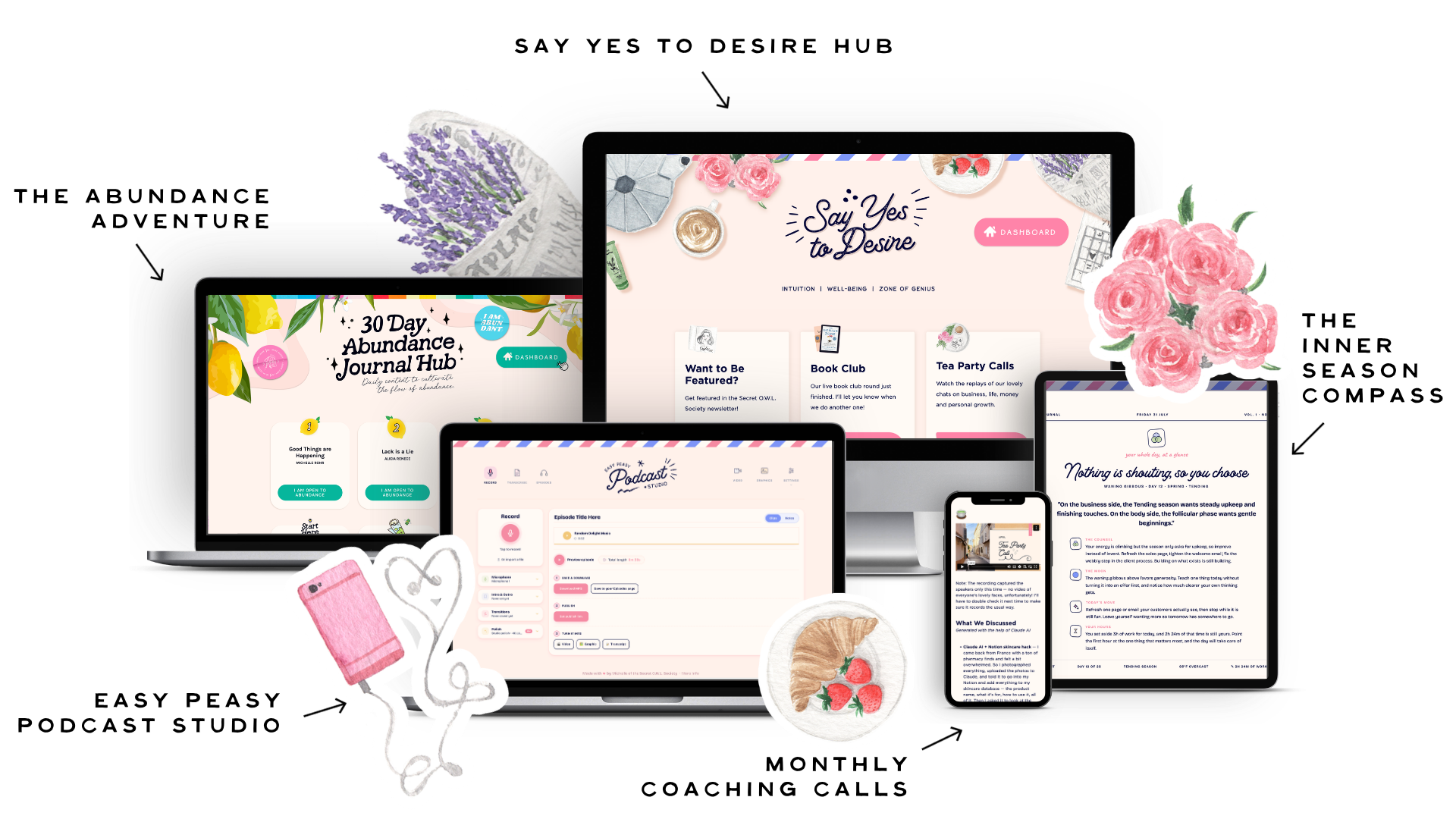
Every month, I get on a group call with the Say Yes to Desire community. The video below is a taste of our July 2026 call! I’m sharing the behind the scenes of a new tool I made just for Say Yes to Desire!
Q: What does the Say Yes to Desire Planner actually do?
You take a short quiz and land in a customized page that reads your cycle phase (or your energy phase if you don't have a cycle), the moon, your business season, the sky where you live, and how many hours you want to work that day. Then it gives you a forecast that combines all of it into one page.
So it might tell you your energy is rising while your business is in its tending season — and instead of starting a whole new side quest, point that surplus at one meaningful improvement. It's not there to tell you what to do. It's there so you go oh yeah, that's what's happening, and tune back into yourself.
Q: The timer feels different from other productivity timers. What's the intention behind it?
You decide how much time you want to work before you work. The timer counts down from that, and when you're near the end it asks what can move to tomorrow and what can be reprioritized.
It's not about being more productive. It's about working as little as possible, because we're done treating ourselves like machines and done sacrificing our wellbeing. I want you working two to three hours a day normally. You'll have launch seasons and hyperfocus seasons — but day to day, if we're not working as little as possible, we're running off a script that isn't serving us.
Q: What's the spell quiz inside the planner?
If you tend to overwork, it might be because of a pattern. So you take a quiz and find out which spell (pattern) you're under — the caretaker, the prover, the doubter, the polisher. For example, the caretaker takes care of everyone else first, so rest never feels allowed. Breaking that spell means letting people carry what's theirs and finally asking what you need.
Then each day you get one spell breaker, a short shift written for exactly that spell. Today's asks: am I doing this from love or from fear of not being needed? Both make sense in your story, and neither makes you wrong — but only one of them needs your whole day. Love is usually satisfied with less than you think. Fear is never satisfied at all.
Q: How do I integrate this with Sacred Systems without ending up with a scattered mess?
Sacred Systems stays your single source of truth. The planner is a lighthearted interface for the day — you look at your to-do list in Sacred Systems and pull today's items into the planner.
I've learned I need novelty and a home base. The home base is what makes the novelty safe. That's also why my tools only hold a day — once the day is done, it's done. Nothing to migrate, nothing to lose track of.
Q: Where does everything I type into the planner go?
It stays in your browser. There's no database, no cloud, no storage, no AI — everything is private on your computer, which also means clearing your browser clears your data, so there's a backup button at the bottom.
You're not paying me a subscription, you're not renting anything, and you don't have to worry about your data sitting on someone's server.
Q: Why podcasting specifically, in the age of AI?
Because it's your voice. People are already asking whether you wrote something or whether AI wrote it — and a podcast settles it. That's the human piece, and everything else can multiply out from it.
I'm not going to sit and turn a transcript into a blog post by hand. I have two kids, and most people are skimming the blog post or finding it through search anyway. So I let Claude do that part and I say so at the bottom of the post. But my podcast and my videos are me, raw thoughts, no AI, not even for ideas. Use AI for what you don't want to do, and keep the human part human.
Q: I want to make low-cost offers, but I keep thinking I need an audience first — so I do nothing. What now?
Step 1: Don't create for an audience. Create for yourself. Make what you want to use.
Step 2: Put it up with a price tag.
Step 3: Tell your story, because now you have one: you solved your own problem.
Q: But everything I've been taught says focus on the customer and their pain points.
That path gets less and less authentic the further you walk it. You're telling an invisible avatar about a made-up problem, describing a solution you may not even use yourself. Flip it — you're the avatar, your pain points are the ones you're solving, your story is the one you're telling.
We get inspired by witnessing someone else reclaim their life. Every product I make, I say plainly: I needed this for me. That’s why I made it and now I’m sharing it with you.
Q: You've called old-school business codependent. What do you mean?
I want to be careful with this one, because the impulse underneath it is almost always a good one. Most people who end up in this pattern got there by genuinely caring.
The old model asks you to begin by leaving yourself. Cross the street, study your customer avatar’s pain points, speak to her problem, build the thing she needs — and then, somewhere down the line, if you've been useful enough, something comes back to you. That's the shape of codependency: “I need you to be okay for me to be okay.”
It rarely lands the way you hoped. What's left is resentment, which is a confusing thing to feel when you started out wanting to be generous.
The healthier version is simpler, and I think kinder to everyone involved. You stay on your side of the street. You solve your own problem, you create the thing you need, and you tell the truth about how it's going.
Here's the part I want to say carefully. On this call I've heard what this work has meant to you, and I don't hold that lightly at all. But there's no “I have to help these women” energy in me — and I've come to think that's precisely why it works. If I were carrying that, you'd feel it. You'd feel the weight of being someone I needed to rescue, and the underlying expectation that always comes attached.
Instead I'm over here solving my own problems, figuring out how to enjoy my own life, and sharing what comes out of that. What reaches you is the overflow.
Q: So where does the business fit?
Old business trained us to build something successful so that we can have a life we love. That's been so damaging in my opinion.
This is what I believe: Have a life you love and let the business be the byproduct.
The more you pour into yourself, your garden, your walk with the dog, reducing friction and maximizing joy — the more you have to say and the more energy you have to say it with. People feel it. When I started, I had no money, I was living in a toxic environment, and riddled by trauma patterns I didn't even know I had. But even in those circumstances, I decided that I was going to take 100% responsibility for my life. Shortly after, I started a blog I called The Secret O.W.L. Society where I just shared what I was learning. The business I have today is a byproduct of that reclaiming my power to take responsibility for my life.
Q: Is your wardrobe still minimal?
Still minimal, and I've basically been wearing the same three dresses for 2 years! Part of it is ADHD and sensory issues.
A ten-item quality wardrobe is one of the biggest friction savers there is. And it's cheaper than it looks: a $200 dress worn a hundred times has cost you less per wear than the cheap things you wore twice.
Q: What does money have to do with working less?
If there's a voice in the back of your mind saying I need money, I need money, that doesn't get solved by building a bigger business — that gets solved by having your personal finances in order. As long as I neglected the saving and investing piece, my business was just the place where I overcompensated for that neglect.
Your business shouldn't be the thing that financially solves everything. Learn to invest outside of it. The Simple Path to Wealth by J.L. Collins is what made me realize how simple it actually is to make my money work for me instead of the other way around and The Abundance Adventure in Say Yes to Desire shows exactly how I’ve applied the lessons in that book.